Prescribed Fire Update from Valantijn Hoff
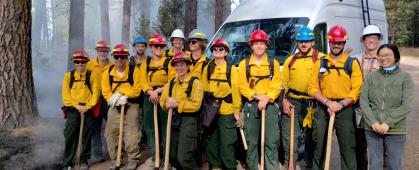
Where there is smoke, there is fire, is the old adage. This fall, at Lubrecht Experimental Forest, the fire was there precisely for the smoke. On three different days, UM FireCenter staff and UM students ignited their drip torches and implemented small, prescribed burns with the production of smoke as the main goal. The first burn was completed on October 1st just east of Jones Pond and measured only 1/10 of an acre. The fuels consumed by the flames consisted mainly of pine needles, small diameter sticks, and some grass and brush.
A Conversation with Maggie Epstein: Large Language Models in Fire Science and Bridging the Firefighter–Researcher Gap
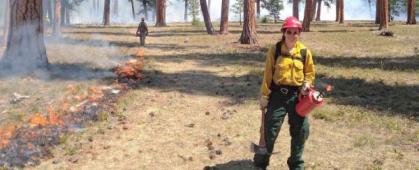
Maggie Epstein is a second year PhD student in the Fire Center at University of Montana where she also received her master’s degree. She comes from a wildland fire fighting background and worked on a rappel crew in northern Idaho. Her research revolves around bridging the gaps between operational firefighting and fire science.

A Conversation with Wade Permar: Smoke Van Updates and its Role in Fire Science
Dr. Wade Permar is a key SMART FIRES team member at the University of Montana. He specifically works on the Fire and Smoke Science thrust's new "super van," a mobile smoke sampling lab with revolutionizing UM's and Montana's ability to ask and answer questions about smoke chemistry, a crucial part of understanding both wild and percribed fire. Below read Permar's update on the van's progress as well as the role it plays in SMART FIRES. What is the update on your work and the smoke van since the September All Hands Meeting?
Women in STEM Feature: Lucy Owen
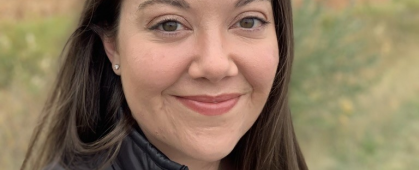
Where did you grow up?I grew up in Kentucky. I was born in a very rural part of Kentucky, and that's where I spent the first several years of my life before I moved to the big city of Lexington, Kentucky.How did you get into STEM and research?
NSF by the Numbers
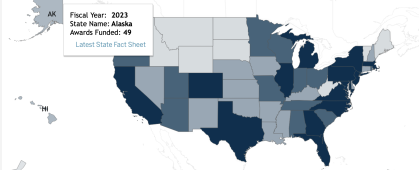
NSF provides a helpful resource called NSF by the Numbers.
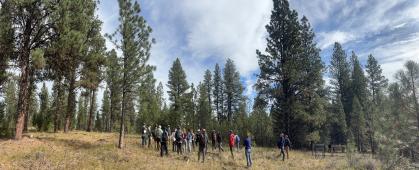
SMART FIRES team investigates citizen science opportunities during Lubrecht Experimental Forest visit
On a beautiful fall day in September, a team of Montana NSF EPSCoR researchers, students and outreach professionals from several Montana colleges and universities gathered at the University of Montana’s Lubrecht Experimental Forest near Greenough, Mont.
NSF E-RISE Awards 2024
The U.S. National Science Foundation has awarded $35 million through the Established Program to Stimulate Competitive Research (EPSCoR) Research Incubators for STEM Excellence Research Infrastructure Improvement (E-RISE RII) to boost research competitiveness, build partnerships across academic institutions and non-academic sectors and create workforce development opportunities.
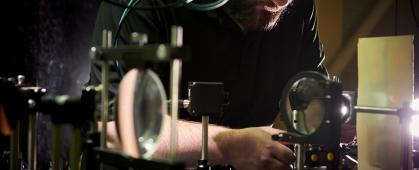
$41M award to Montana Tech Hub
A regional technology hub focused on photonics and smart sensors, of which Montana State University is a founding member, will receive a $41 million federal grant to help create tech jobs across Montana.
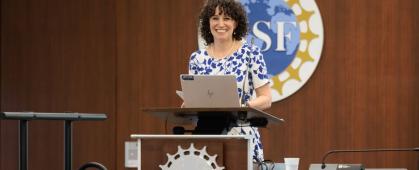
2024 EPSCoR Annual PI Meeting Presentations
Access to presentations from the 2024 NSF EPSCoR Annual PI meeting. These presentations provide helpful information on ESPCoR funding opportunities.You can access meeting presentations web page here.
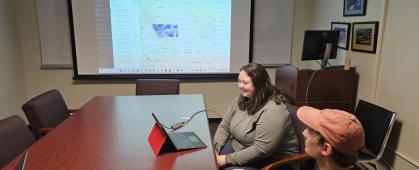
SMART FIRES Smoke Vulnerability GIS Mapping Project
Kristen Intemann, Professor of Philosophy and Director for the Center for Science, Technology, Ethics, and Society (C-STES) at Montana State University (MSU), is working with graduate students in Land Resources and Environmental Sciences (LRES) at MSU to construct maps to analyze which communities and Tribal Nations are particularly impacted by both wildfire smoke and smoke from prescribed burns in Montana and across the U.S. This project is a product of the Social Psychology, Economics, and Ethics (SPEE) thrust of the SMART FIRES project.
Upcoming Events
Indreland Audubon Wetland Preserve
Earth Week Community Citizen Science Program
April is Citizen Science month! Join us for this free, family-friendly program to explore the beautiful Indreland Audubon Wetland Preserve while learning how you can contribute meaningful scientific data—locally, statewide, and globally.
Indreland Audubon Wetland Preserve
Earth Week Community Citizen Science Program
April is Citizen Science month! Join us for this free, family-friendly program to explore the beautiful Indreland Audubon Wetland Preserve while learning how you can contribute meaningful scientific data—locally, statewide, and globally.