Inside the University of Montana’s “Smokevan”: A Mobile Lab Transforming Prescribed Fire Smoke Research
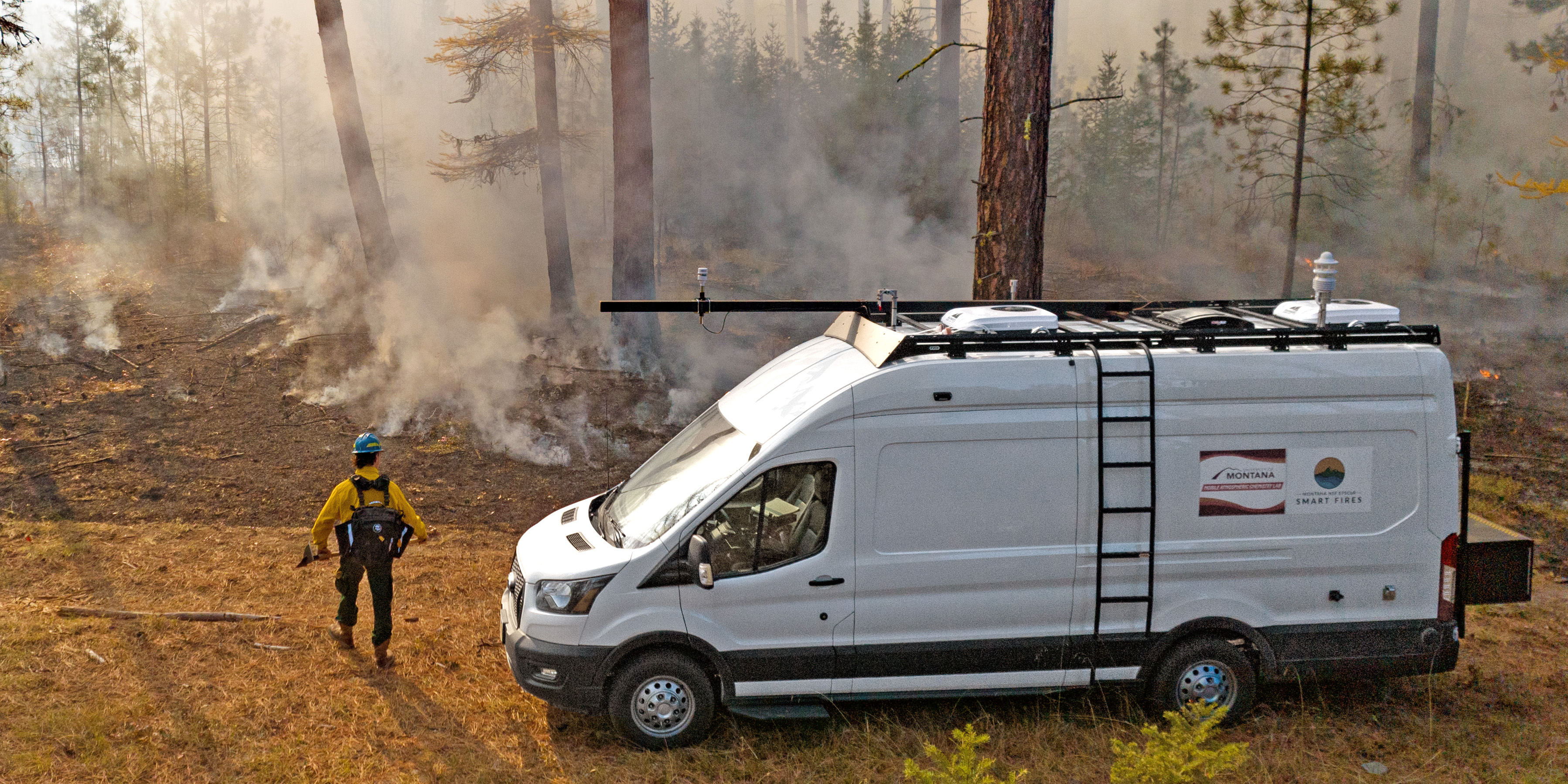
The Smokevan—a mobile air quality lab built and operated by the University of Montana—brings atmospheric science directly to the edge of prescribed fires. During burn operations at UM’s Lubrecht Experimental Forest, the team positions the van at key points around the perimeter, drawing ambient air into a suite of precision instruments. With these measurements, UM atmospheric chemist Dr. Wade Permar is determining how prescribed burn smoke compares with wildfire smoke—and what those exposures mean for crews on the ground.
For Permar, the Smokevan answers a challenge he encountered earlier in his career. As a PhD student, he studied wildfire emissions from the air, flying aboard research aircraft loaded with as many instruments as they could safely carry. The data were useful, but the approach came with unavoidable constraints. “Aircraft are expensive, difficult to outfit with the full suite of sensors, and you can only fly so low or at certain times of day,” Permar explains. “Sometimes, you just can’t get to the smoke plume.” The Smokevan was designed to overcome those limits—bringing the laboratory to ground level and positioning it directly in the path of the smoke, right where fire crews are working.
A Rolling Chemistry Lab
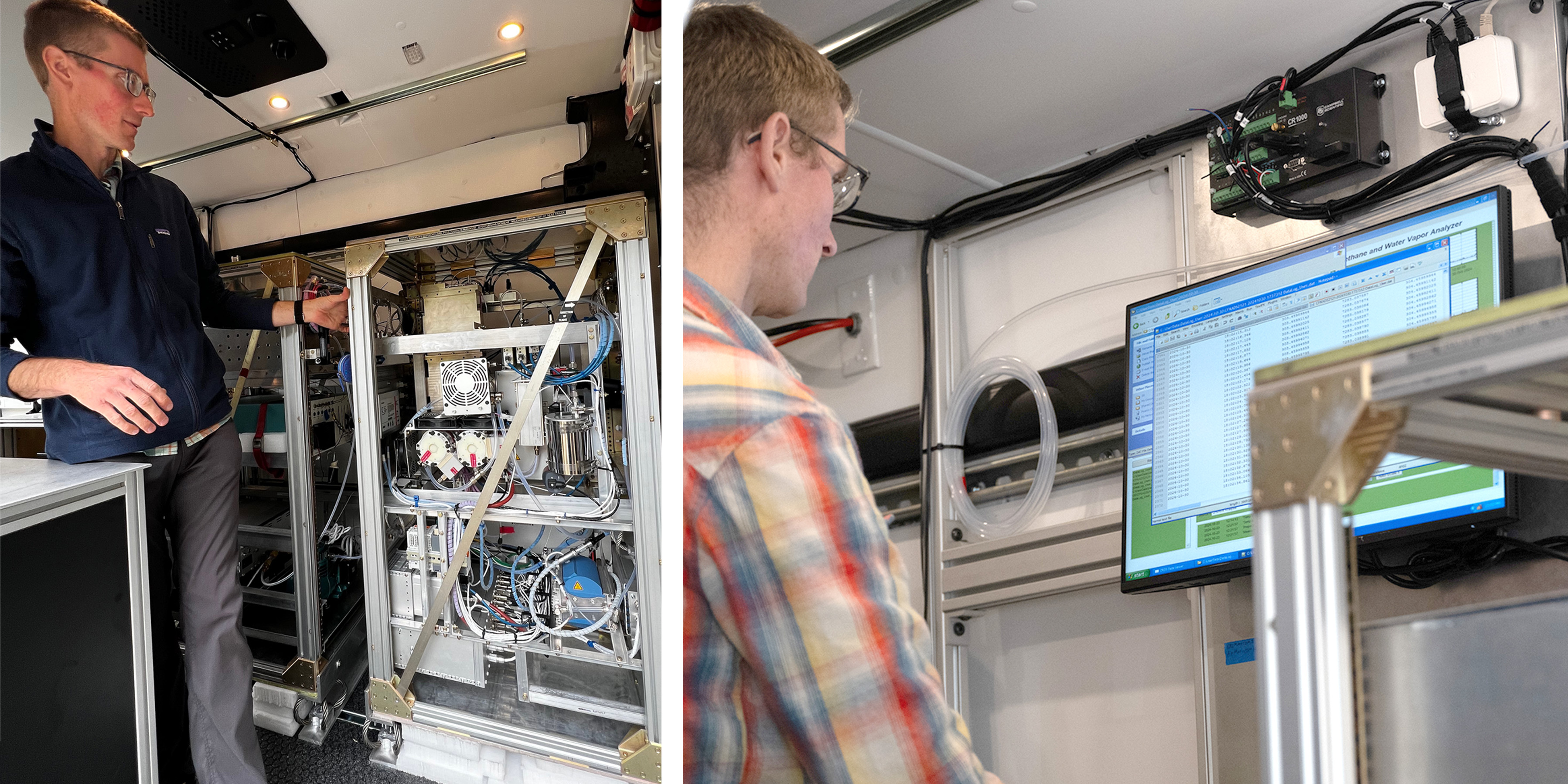
The Smokevan houses a tightly integrated instrument suite that pulls ambient air into analyzers through in situ inlets. The system measures:
- Particulate matter (PM1–PM10) every 6 seconds
- CO, CO₂, CH₄, H₂O every 1 second
- Ozone (O₃) every 2 seconds
- NO and NO₂ every 5 seconds
- VOCs—160+ species at 1 second, including BTEX, formaldehyde, methanol, and terpenes
- Aerosol optical properties (black carbon and brown carbon) every 1 second
To track how smoke forms and moves, the van also continuously logs GPS (lat/lon), altitude, wind speed/direction, relative humidity, and temperature.
The setup is designed for field reliability. All instruments can run for a day on a battery bank that stores roughly the amount energy a typical household uses in 24 hours. A generator rides along as a backup but has rarely been needed. On campus, the van has a dedicated parking spot near the Chemistry building with a permanent charging outlet. Routine maintenance is light for the instruments, but the van stays heated all winter to protect electronics. Permar monitors system health and battery status via remote management software.
Why Mobile Ground Sampling Matters
The Smokevan has been operating for more than two years, with 13 prescribed burn deployments to date. While it was funded under the SMART FIRES project to improve smoke science and decision support, the team intentionally built it for broader applications. For example, Permar’s team recently spent two months on Colorado’s Front Range sampling ozone and urban air pollution.
For prescribed fire, the van provides the kind of high frequency, ground level data needed to understand exposure—especially for the people closest to the flames. “We’re focused on the profile of burn emissions and what those components mean for health, mainly for the fire crews onsite,” Permar says. The team also compares these data with wildfire measurements (collected by aircraft) to understand how prescribed fire smoke differs.
What the Data Are Showing
A key finding is that certain hazardous gases can reach concentrations high enough to be harmful, in addition to the well-known risks from particulate matter. “On prescribed burns, we often see higher VOC (Volatile Organic Compound) emissions relative to particulate matter, whereas in wildfire smoke, it’s generally the opposite.” Permar says. That’s partly due to smoldering combustion conditions common in prescribed fire and the simple fact that crews are much closer to the source than they typically are on large wildfires, raising potential exposure.
The Smokvevan’s VOC analyzer detects a broad set of compounds, including BTEX (benzene, toluene, ethylbenzene, xylenes), formaldehyde, methanol, and terpenes—species that can drive ozone formation and secondary aerosol production as plumes age. Coupled with black and brown carbon measurements and meteorology, the team can track how plumes transform over minutes to hours and which species travel farthest.
Informing Smarter Fires
Prescribed fire is essential for ecosystem health and wildfire risk reduction, but smoke exposure remains a concern for crews and nearby communities. By quantifying what’s in the smoke at the scale people breathe it, the Smokevan is helping translate atmospheric chemistry into practical guidance—from exposure aware crew practices to better model inputs for air quality forecasts and health messaging.
“The more precisely we understand emissions and near‑field exposure, the better we can protect people while achieving the ecological goals of prescribed fire,” Permar says. “That’s the point of bringing the lab to the line.”