


The SMART FIRES project is leveraging cutting-edge technology to better understand fire behavior, smoke dispersion, and fuel conditions. Three key instruments—High Spectral Resolution Lidar (HSRL), All-Sky Polarization Imager (ASPI), and the Smart Unoccupied System Hyperspectral Imager (SUSHI)—are at the core of this effort. Each provides unique insights, and together they form a powerful toolkit for prescribed burn research and management.
Advanced Sensors for Fire and Smoke Science
High Spectral Resolution Lidar (HSRL)
Developed by Dr. Kevin Repasky and graduate student Dylan Maxwell
What is the HSRL?
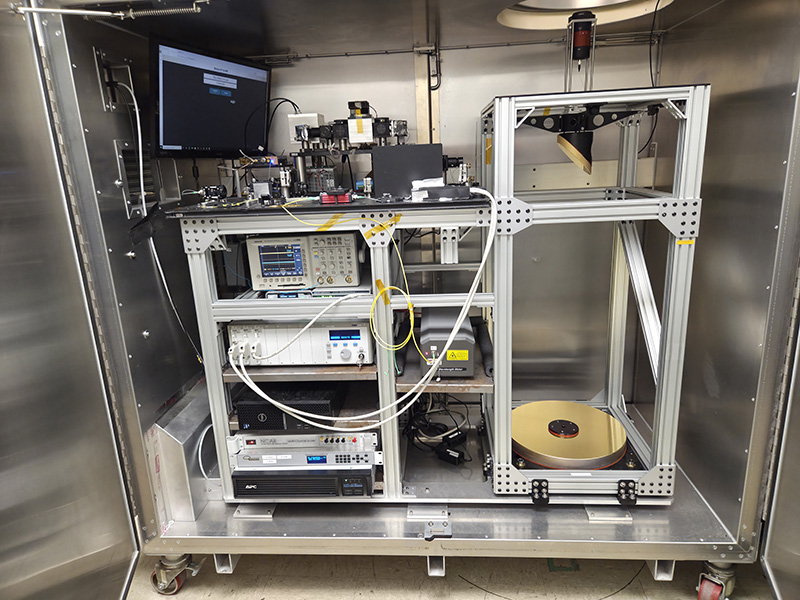
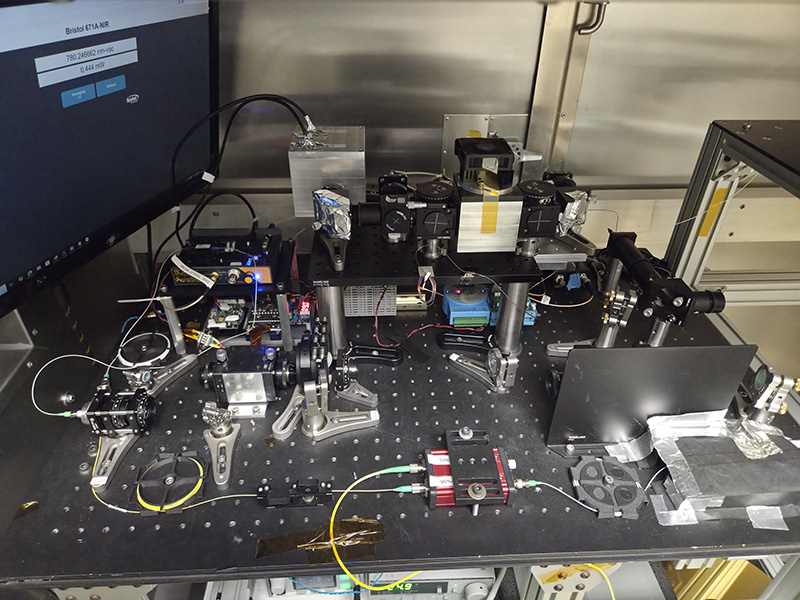
The HSRL is an active optical remote sensing instrument designed to profile the lower atmosphere. It sends out 7,000 laser pulses per second and measures the time it takes for light to scatter back from particles in the air. Each returning photon provides a location data point, allowing researchers to build a detailed picture of aerosol distribution and atmospheric structure.
Why is this important for SMART FIRES?
Smoke movement depends heavily on atmospheric structure, particularly two layers:
- Mixing Layer: A turbulent zone near the surface where air is well-mixed. Smoke trapped here stays dense and close to the ground, impacting local air quality.
- Planetary Boundary Layer (PBL): The lowest part of the atmosphere influenced by the Earth’s surface, typically extending up to 1–3 km during the day. Smoke rising above the PBL enters the free atmosphere, where stronger winds can transport it over long distances.
By profiling aerosols and these layers, the HSRL helps predict where smoke will go and how it interacts with weather systems. This capability will be integrated with other technologies to provide real-time insights during prescribed burns and optimize timing for safer, more effective fire management.
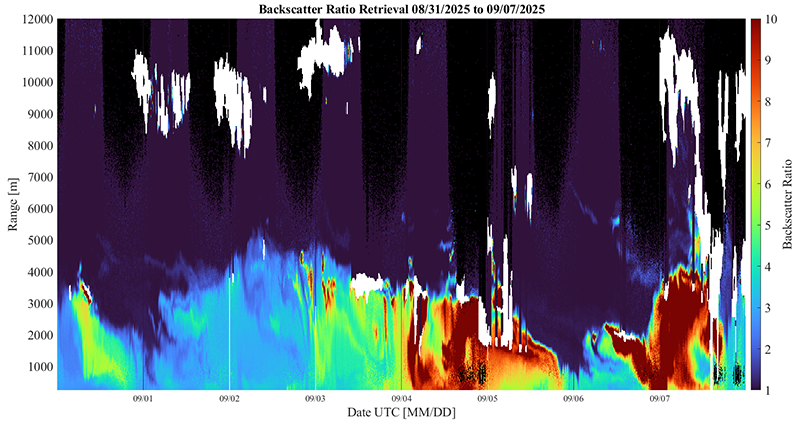
The colorful plot shown here displays the backscatter ratio as a function of range (y-axis, in meters) and time (x-axis, in UTC days). The backscatter ratio represents the total light returned from aerosols and molecules divided by the molecular return alone. A ratio of 1 indicates only molecular scattering, while values greater than 1 reflect increasing aerosol contributions. Color bars start at 1 and extend upward, with heavier smoke days showing a wider range due to higher aerosol loading. White areas indicate clouds that have been masked from the data.
Technical Highlights
- Spectral Resolution: Differentiates aerosols from molecules like water or oxygen.
- Aerosol Characterization: Identifies scattering properties (e.g., dust vs. smoke).
- Field Deployable: Measures about 1 × 2 × 2 meters; being outfitted with housing and shock absorbers for transport to sites like Lubrecht Experimental Forest.
|
|
|
All-Sky Polarization Imager (ASPI)
Developed by Dr. Joe Shaw and graduate student Morgan Hasenmyer
What does ASPI do?
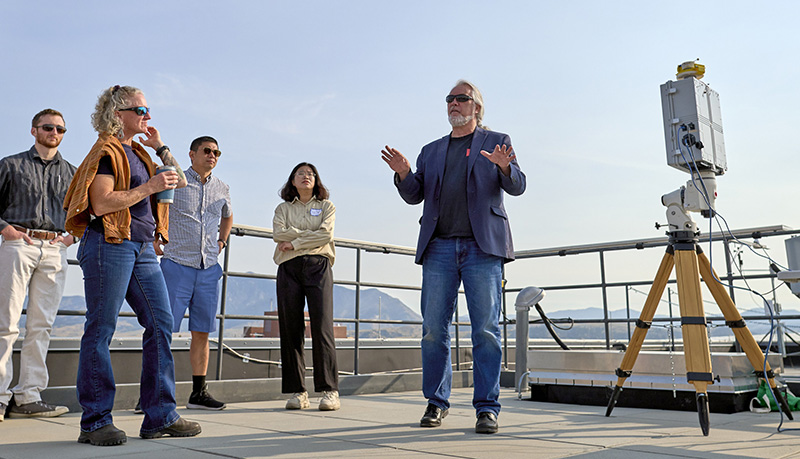
ASPI is a passive remote sensing instrument that captures the polarization state of light across the entire sky. Using a specialized camera with a microgrid polarizer, ASPI measures both the intensity and direction of oscillation of incoming light. These patterns reveal particle shape and orientation:
- Ice crystals in clouds create distinctive halos, such as the 22-degree halo.
- Analysis of these patterns allows inference of particle size distributions and densities, though not exact composition.
ASPI’s full-sky view sets it apart from other imagers that only capture small portions of the sky. It has already been deployed in field campaigns, including a three-day test at Lubrecht Experimental Forest, and is currently in performance assessment.
How is ASPI similar to and different from HSRL?
- Similarities: Both characterize aerosols and atmospheric conditions for smoke behavior analysis.
- Differences: HSRL is active, sending laser pulses for vertical profiles; ASPI is passive, analyzing natural light polarization for a horizontal, integrated view.
Together, they provide complementary perspectives—HSRL maps vertical structure, ASPI captures the full-sky distribution.
Smart Unoccupied System Hyperspectral Imager (SUSHI)
Developed by Dr. Ross Snider and graduate student Nat Sweeney in collaboration with Resonon
What is hyperspectral imaging?
Hyperspectral imaging splits incoming light reflected from a target into hundreds of narrow wavelength bands. This reveals subtle differences in material properties invisible to standard cameras.
For SMART FIRES:
SUSHI will scan ground fuels and classify areas as likely or unlikely to burn, creating GPS-based maps from the reflectance in the visible to near-infrared range (400 to 1000 nm).It can work alongside other varieties of imagers for richer data.
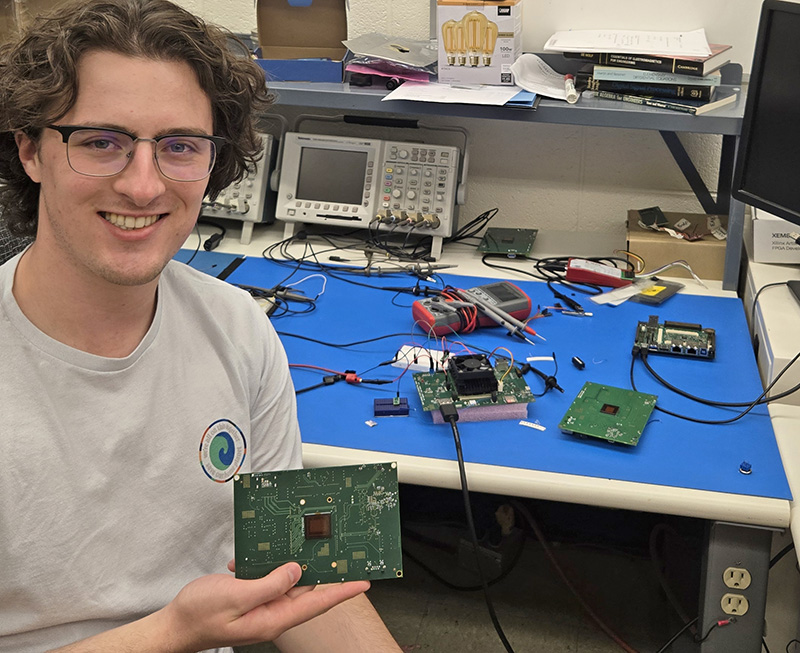
Unlike traditional systems that store data for later processing, this “smart” version integrates machine learning directly into the hardware for real-time classification. Sweeney integrated a reconfigurable FPGA* chip with a CMOS** detector to allow for implementation of custom hardware to enable the real-time analysis.
* FPGA: Field-Programmable Gate Array - a reconfigurable integrated circuit, meaning it can be programmed and reprogrammed after manufacturing.
** CMOS: Complementary Metal-Oxide-Semiconductor - a type of image sensor commonly used in cameras, including hyperspectral imagers.
Why is this unique?
Smart hyperspectral systems are rare. While Resonon provides the optics, Sweeney’s design adds intelligence for immediate decision-making. Features include:
- Optics from Resonon
- CMOS sensor
- FPGA chip for reprogrammable real-time processing and inferencing
- Custom circuit boards to integrate the FPGA chip and CMOS sensor
Designing circuit boards is painstaking work. As Sweeney joked, “I’ve learned to eat a big breakfast before heading into the soldering lab!”
Future goals include miniaturizing the system, enabling wireless connectivity to the camera, and investigating unique distillation methods for machine learning models.
Beyond fire science
This technology is adaptable—for example, detecting plant diseases in agriculture, such as identifying potato viruses in large batches.
Why these instruments matter
HSRL, ASPI, and SUSHI each provide a different perspective:
- HSRL: Vertical profiles of aerosols and atmospheric layers
- ASPI: Full-sky polarization patterns for particle distribution
- SUSHI: Ground-level fuel characterization with real-time analysis
Combined with in situ weather and air quality sensors and NASA satellite data, they form a comprehensive system for understanding fire emissions, smoke transport, and fuel conditions—critical for planning and managing prescribed burns.